Five types of wealth
Sahil Bloom on five types of wealth. The real argument is not about accumulation. It is about knowing when a pillar is enough.
24 Mar 2026
Read 16 to 24 March 2026. Sahil Bloom, 5 Types of Wealth.
The central argument: most people spend their lives optimising for financial wealth while quietly neglecting the other four. Not because money is unimportant, but because it is the most legible. You can put a number on it. The other four are harder to measure, easier to defer, and more consequential in the end.
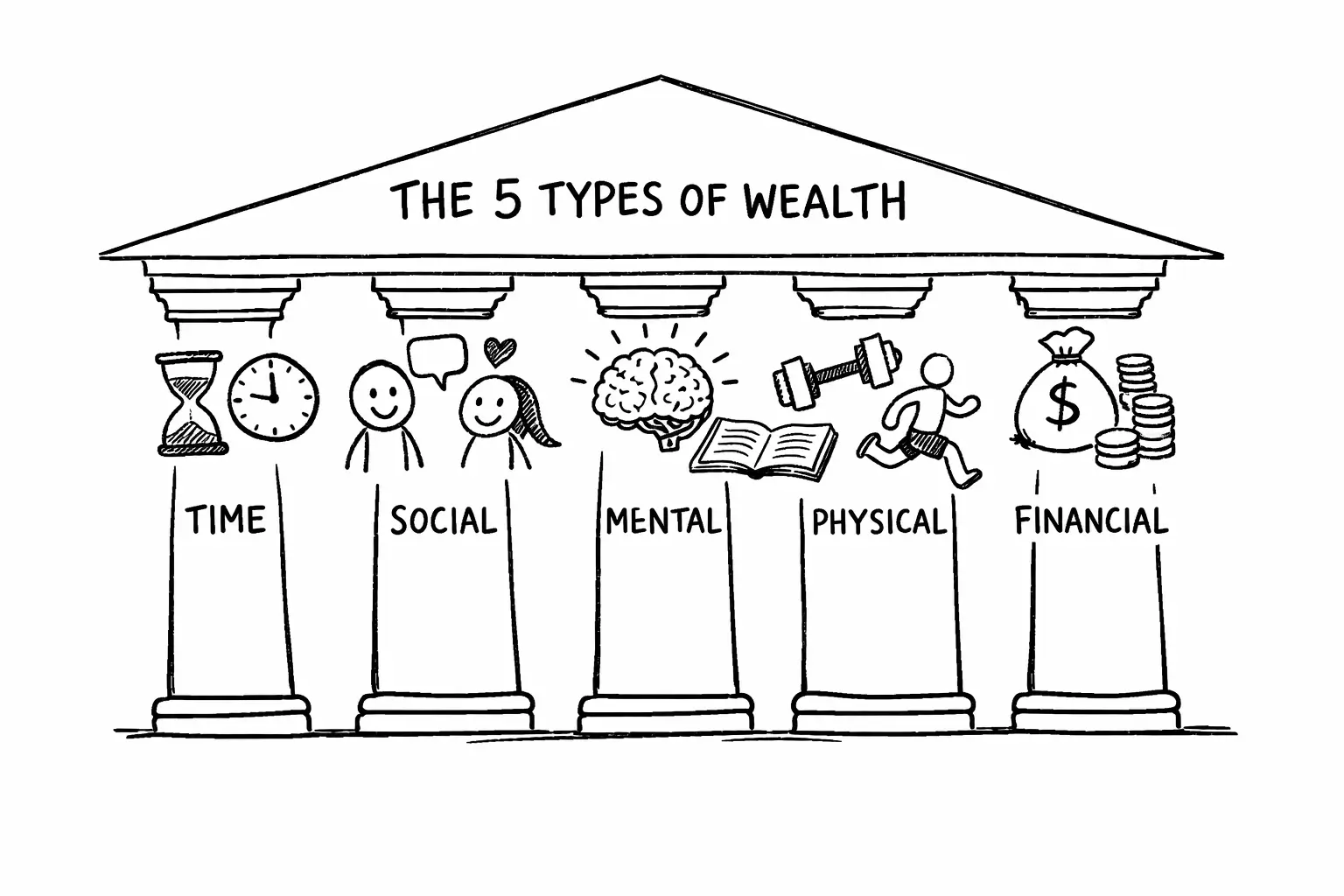
I think of them as pillars rather than a circle or a loop. Each one is load-bearing on its own. They interact, but none of them is simply a function of the others.
Sahil opens with the story of Siddhartha Gautama, a prince who had everything: wealth, comfort, a kingdom. He chose to leave it all to understand suffering and find a way through it. The point is not that wealth is bad. The point is that financial wealth alone could not answer the questions that mattered most to him.
The concept he keeps returning to is lagom, a Swedish word meaning just the right amount, neither too little nor too much. Real wealth is not about having more. It is knowing when you already have enough. That distinction matters: this is not an argument for settling or quiet resignation. It is an argument for actually defining what sufficiency looks like for you. Doing that well is harder than it sounds. Most people never stop to ask the question.
Worth saying upfront: the ideas are not new. Sahil draws from Matthew Walker on sleep, Andrew Huberman on neuroscience and physical health, Peter Attia and Andy Galpin on exercise and longevity, Ramit Sethi and Morgan Housel on money, and a lot of popular podcasts besides. The book is synthesis, not original research, and he is upfront about that. If you have already read widely in this space, you will recognise most of it. Treat this as a gateway to those sources, not as a destination in itself.
Time wealth
This one landed hardest. I lost a few close people a few years ago and I am still carrying that. Grief has a way of making time feel very concrete. You stop being able to pretend it is abstract.
The book frames time as the foundation for all the other pillars. You cannot invest in relationships, health, or mental clarity without directing your time toward them. The Eisenhower matrix comes up here, which I have seen plenty of times. In this context the question is slightly different, though: not just urgent versus important, but whether your time is actually going toward what matters, given that you will not always have more of it.
Social wealth
I already thought about social connection in a vague way, but the loneliness angle landed differently. Sahil describes how hard it is in modern life to have people you can say difficult things to, and people who will say difficult things back. I had not quite put it that directly before.
Quality over quantity is not a controversial point. The loneliness piece made it more specific: it is not about having enough people around. It is about whether the people around you actually know you.
Ferrazzi’s Never Eat Alone sits behind a lot of this section for me. Read it years ago.
Mental wealth
Mindfulness and journaling show up here, as expected. Reading this section sent me back to Lori Gottlieb’s Maybe You Should Talk to Someone, a book I read long before this one.
The mental and social pillars are more connected than the book’s structure implies. Social isolation compounds mental difficulty. How you are doing mentally shapes how you show up in relationships. The boundary between the two is porous in practice.
Physical wealth
Sahil draws from Peter Attia’s Outlive and Andy Galpin’s work on exercise physiology, then distils it to basic protocols for people building habits from scratch. My background is hybrid: marathons, bouldering, lifting, Hyrox, hiking. This section did not have much to offer me. Attia’s Outlive is the better read if you want to go deeper on the longevity side.
Financial wealth
Most of the ideas here come from Morgan Housel, particularly The Psychology of Money. Positioning financial wellbeing as a foundation rather than a goal is the useful part. Money is the pillar easiest to measure and therefore easiest to over-index on.
One thing worth noting: there is a line attributing a quote about compound interest to Einstein. This is a well-known myth. Einstein almost certainly never said anything about finance. Small thing, but it erodes trust in a synthesis book.
If you have already read Housel, this section is mostly familiar.
What the book asks you to reconsider
This is a solid introduction. It will not offer much if you have already read the sources it draws from, but if you have not, it covers five areas worth taking seriously and points clearly to where to go next.
The lagom idea is what I will carry. Not “how do I build more of this” but “do I actually know what enough looks like here.” For most people, myself included, the harder question is the second. It is easier to keep optimising than to stop and define the target.
One thing I will actually do differently: be more deliberate about time. Not in the productivity sense. Just more honest about where it goes and whether that reflects what I care about.
Same time next thought.